
A New Polymorph Mineral from Mammoth-St. Anthony Mine, Tiger, Pinal County, Arizona
With a little background on why this historic locality is so important to mineral collectors.
The Mammoth-St. Anthony Mine was located near a town named Tiger in Pinal County, Arizona. The town (and the mine) no longer exist having been obliterated by open pit mining operations of the San Manuel Copper Mine a few decades ago. What makes the Mammoth-St. Anthony Mine so important to the mineral collecting community are the very rare minerals that it produced in the past, many of which have have unique and unusual elemental chemistries. In all, there are 111 valid mineral species known from Tiger with 11 of these being designated as type locality valid minerals. Type locality (TL) indicates that the mineral species was first discovered at this location and confirmed by the IMA (International Mineralogical Association) as a valid new mineral species.
I’m a bit partial to this “holy grail” Arizona mineral locality since I was fortunate enough to have identified one of the 11 type locality minerals that came from the Mammoth-St. Anthony Mine. In 2022 I noticed that one of my Tiger mineral specimens had an unusual looking group of small crystals. It proved to be a unique new mineral species and with the help of Dr. Hexiong Yang at the University of Arizona, it was approved by the IMA and named evanichite in July of that year. To date, only two specimens have been confirmed, both from Tiger. But that’s not the main reason I’m writing this article. Since then, I have examined many more old collection Tiger specimens, and late in 2025, I found another specimen with some unusual looking yellow color micro crystals. I sent a sample to Dr. Yang and he had EDS and XRD analyses done at the University of Arizona lab with interesting new results. The small micro size crystals had the chemistry of a known species named fornacite, but there were some important differences which showed up and provided the subject of this article, “a new polymorph mineral.”
Fornacite Polymorph from Mammoth-St. Anthony Mine, Tiger, Arizona.
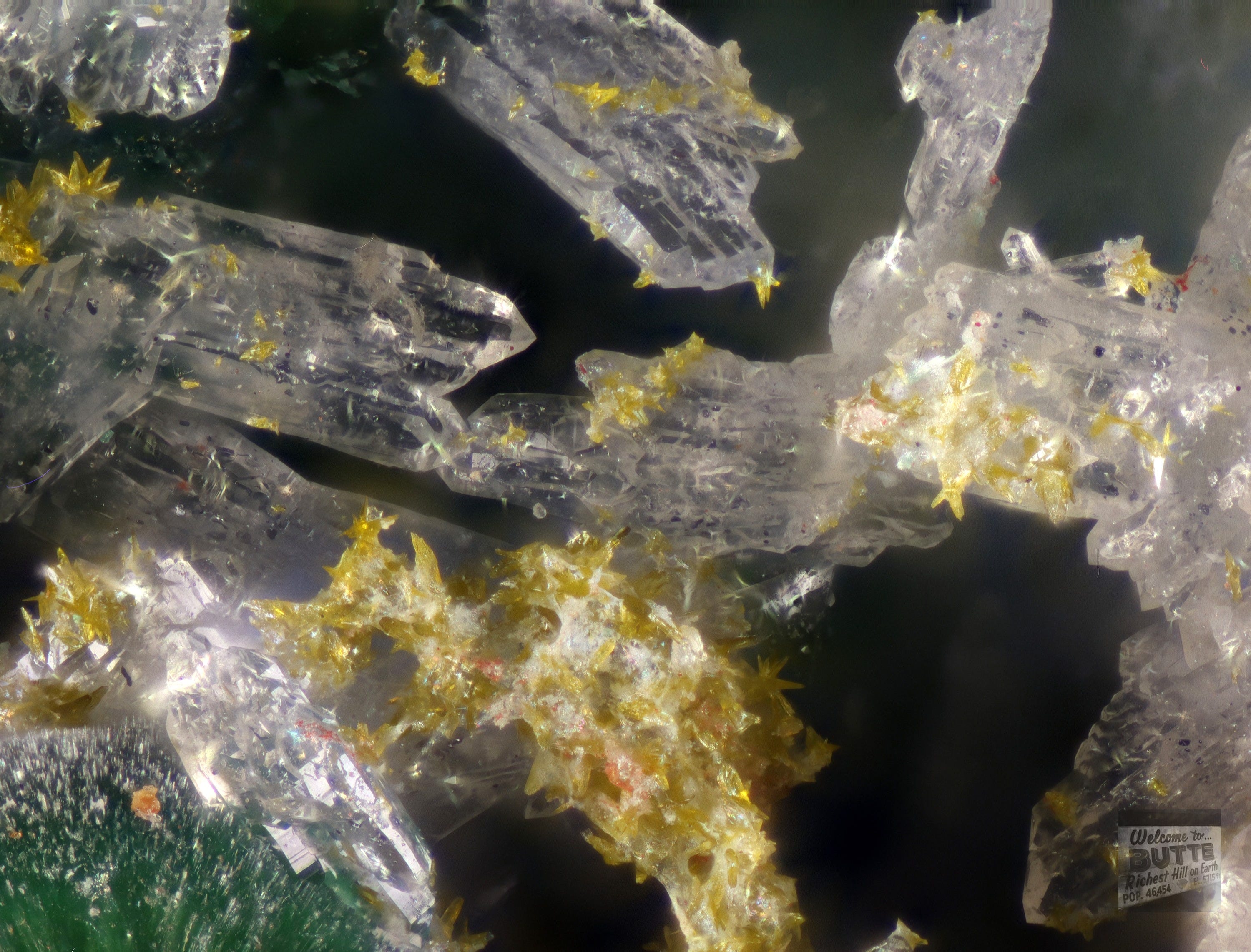
Yellow fornacite polymorph crystals on colorless quartz. Photo by Ron Gibbs 2025.
The photo above, taken by Ron Gibbs, shows yellow color fornacite polymorph crystals with green malachite and colorless quartz crystals. Analyses conducted by Dr. Yang show that the mineral is a new variation in crystal structure of the confirmed species fornacite. In previous years, this variation would have been sufficient to identify the mineral as a separate species and given a new name. But starting in 1998, the International Mineralogical Association (IMA) determined that “most polytypes and polytypoids (specific types of polymorphs) are not to be regarded as separate mineral species.” (https://mineralogy-ima.org/about.htm).
So what exactly classifies a mineral as a polymorph of a species rather than a new mineral? Mindat.org provides a clear definition: “A polymorph mineral is a mineral that shares the exact same chemical composition as another mineral but possesses a different internal crystal structure. This phenomenon, known as polymorphism, occurs when minerals crystallize under varying temperature and pressure conditions, resulting in distinct physical properties.” (https://www.mindat.org/) For reference, the IMA approved formula for fornacite is: CuPb2(CrO4)(AsO4)(OH).
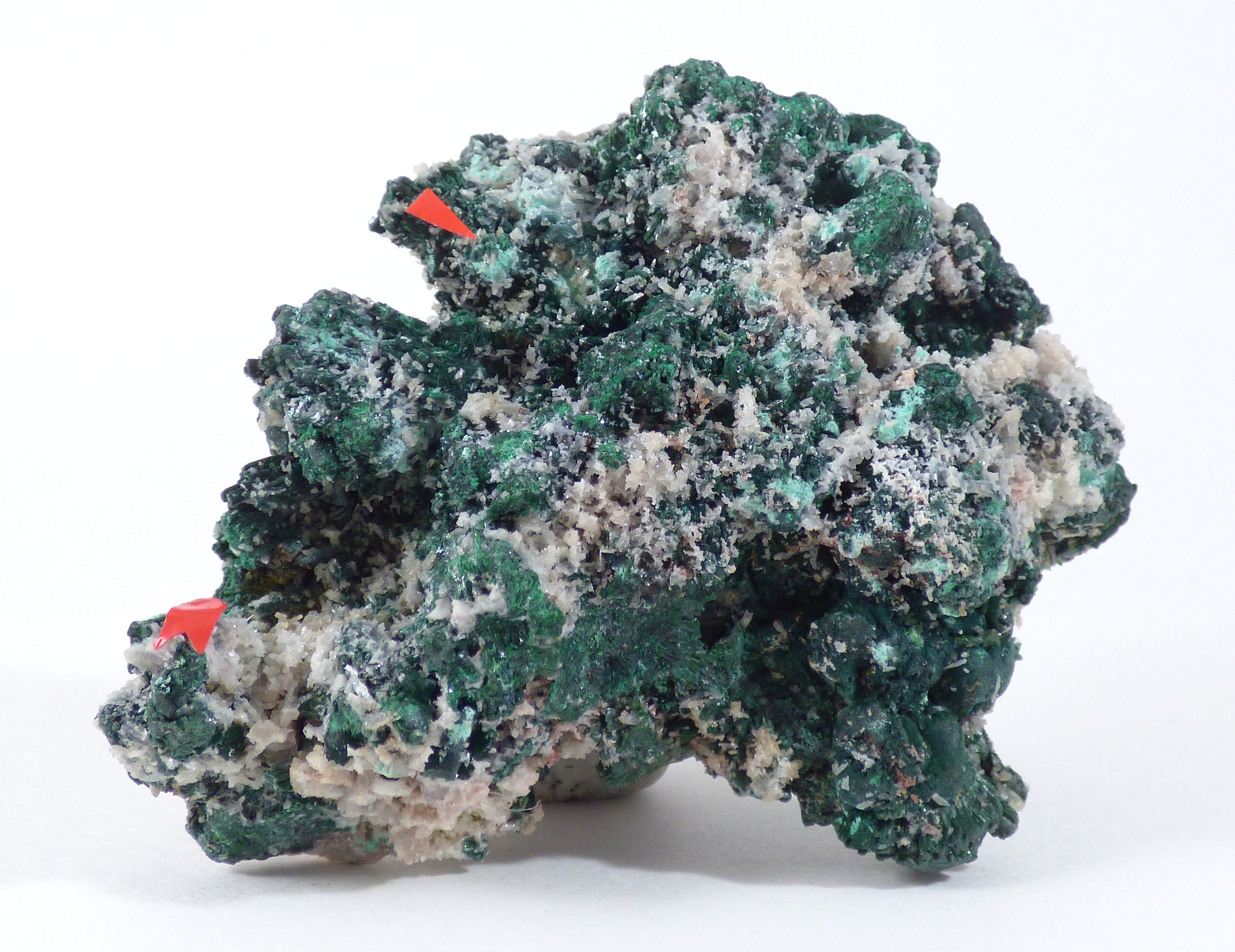
Green malachite and colorless quartz with yellow fornacite polymorph micro size 1-1.5mm crystals. Overall specimen size 7.5cm.
XRD Analysis Results
XRD analysis results for the new fornacite polymorph showing the unit-cell parameters from the single crystal X-ray diffraction:
The unit-cell parameters:
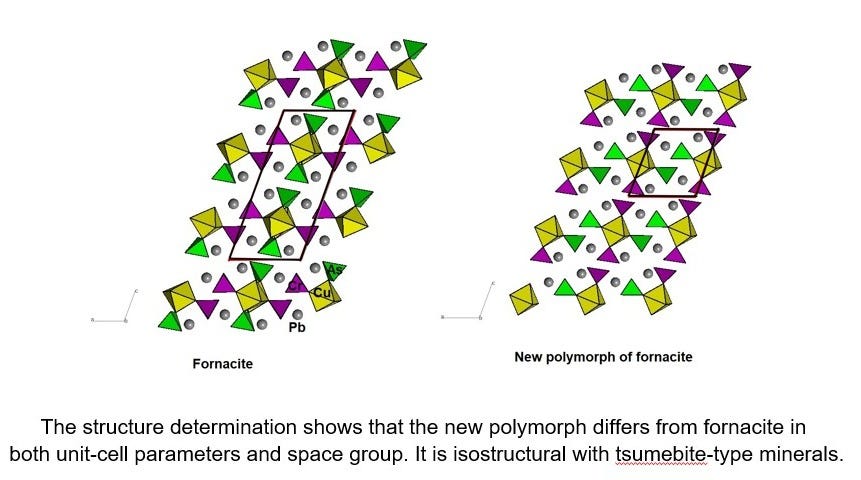
Fornacite: a = 8.1010 Å, b = 5.8930 Å, c = 17.5470 Å*, β = 110.00°
New Polymorph: a = 8.0829 Å, b = 5.9224 Å, c = 8.7832* Å, β = 90.000°
*Note that the c-dimension of the new polymorph is only half that of fornacite which shows a good indication of two different internal crystal structures.
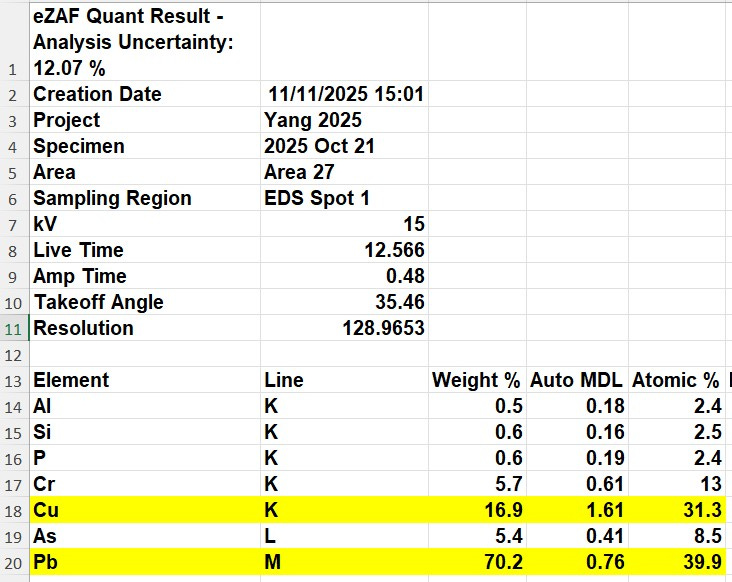
EDS Analysis Results
The ideal atomic ratios for the major elements are Pb:Cu:Cr:As = 2:1:1:1, but for this analysis, Pb:Cu ~1:1. Some Cu may be substituting for Pb. It was unusual to find that the Cu content was considerably higher.
Mineral analysis methods are advancing rapidly today with the advent of artifical intelligence contributing to quicker and more precise conclusions. As we have seen and will continue to see, the guidelines and definitions of the necessary characteristics that determine whether a sample is a new mineral species or not will continue to be refined to even more exact criteria. Many of the prior analyses that were done confirming new mineral species in the past are being scrutinized closely today with more advanced technology tools. Don’t be surprised if the number of discredited species begins to rise and the identification of more polymorph variations rather than new minerals are confirmed.
Those crystals look so similar to fornacite/vauquelinite! What made you suspect something different?
Under the new rules, would kyanite, andalusite, and sillimanite be three polymorphs of one mineral?